
About Angela Dillon
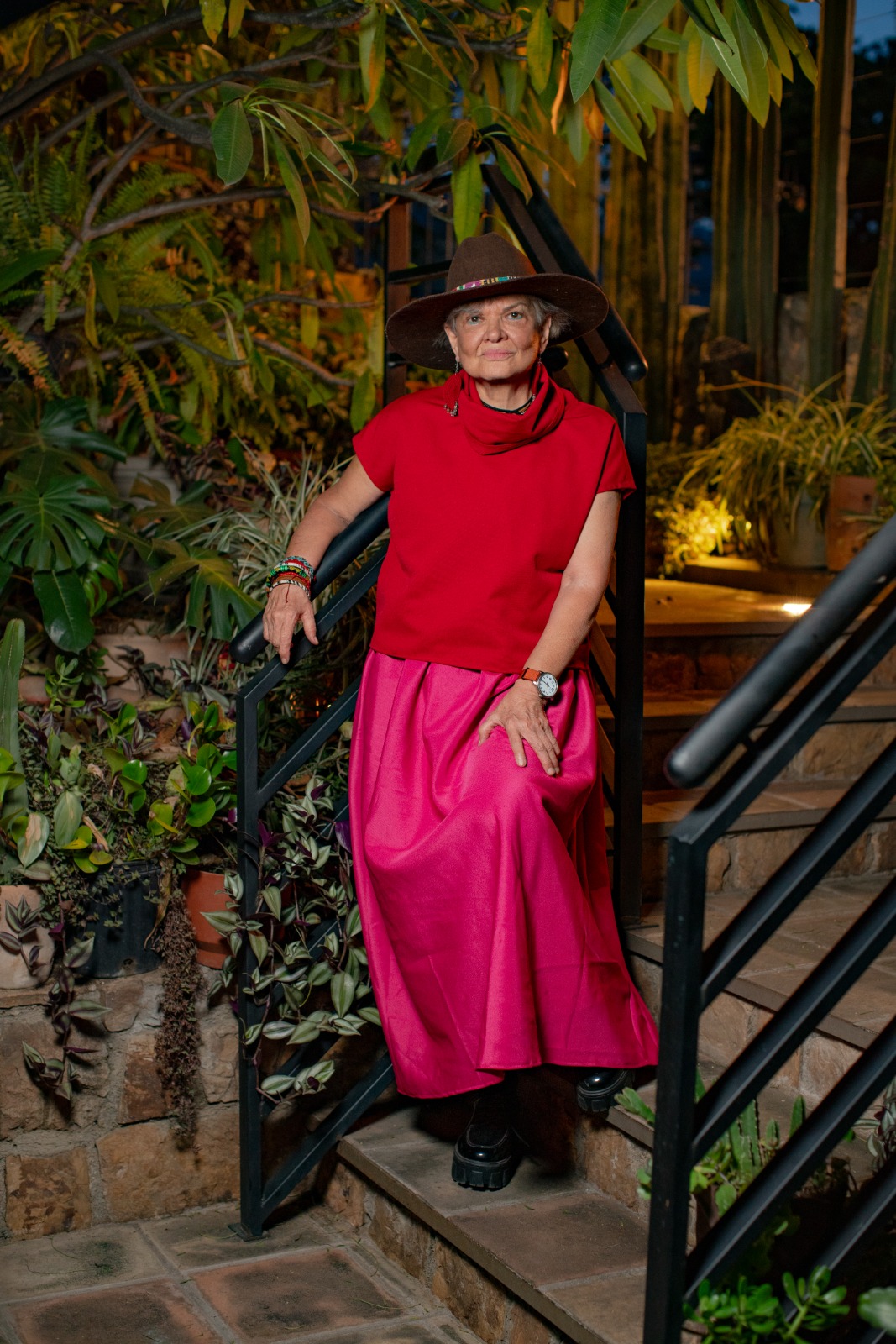
My subject and passions come and go but one never leaves me, my love of dogs, birds and my memories of growing up in the Gulf of Mexico, the Bay of Campeche, Carmen, La Perla del Golfo. Anything happens here in the gulf, I do take it personal. My work is based on these emotions, it has and always will. Some of the paintings and installations reflect on texture, color, or writings where my emotions were that working day.
Angela Dillon’s searingly intense paintings are almost painfully autobiographical and it is necessary to have at least some knowledge of her life to comprehend and appreciate them. She describes herself as umbilically attached to her country of birth, Mexico, and although she has lived in Brazil, Colombia, Venezuela and the United States, as well as in Britain, the sense of belonging to Mexico and its people has never left her, although she has not lived there, except for short visits to her family, for 23 years. The Mexican heritage, and the deeply ingrained Catholicism from which no cradle Catholic ever escapes, informs her work.
She was born in Campeche on the Gulf of Mexico, a small and primitive island with a population of about 30,000 people. At that time the roads were made out of sand and donkey carriages trotted along the cart tracks. When she was 18 she went briefly to High School in the United States, returning home to get married, after which she travelled extensively wherever her husband’s job took him.
Whilst in Bogota she studied art history for three years. Although she had been drawing all her life she did not start painting until she was 23 years old. As influences on her work she naturally gravitated to artists whose use of matiere was similar to her own, in particular Antoni Tapies, Alberto Burri and the Mexican Rufino Tamayo.
Tapies grew up during the Spanish Civil War, and his thickly impastoed paintings are like walls scribbled over with gnomic signs and graffiti, a cry of protest against the Fascist oppressors. Burri, a forerunner of Arte Povera, deliberately used impoverished materials such as sacking, slashed and burned, to make collages of great beauty out of urban detritus. Tamayo’s interest in architecture and his brilliant colours, derived from Mexican folk art, were an important influence, especially because he too was Mexican.
The work of all these artists nourished Dillon’s own development. Her paintings are imbued with texture, an ever-present reminder of the sand, mud and grit of her birthplace. A major turning point in her life was when she came to Scotland and enrolled at Gray’s School of Art, Aberdeen. She was very much influenced by her tutors, not so much in their technique as by their attitude to work — not only the puritan work ethic but also the sense of history and suffering which is endemic in so much Scottish art.
Many Scottish artists are concerned with the loss and displacement caused by the savage Clearances in the middle of the 18th century when large numbers of Scots were forced to emigrate. This must have rung a bell with Dillon, herself so far from her own homeland and acutely aware of the savagery with which many of the indigenous people of Central America were being treated.
At the time she was using bright colours, brought with her from memories of Mexico, which chimed with the legacy of the Scottish Colourists.
After graduating with Honours from Gray’s School of Art she moved to London and enrolled as a postgraduate at the Royal College of Art.
This coincided with a crisis in her personal life. She says: “My whole world collapsed”, a cataclysmic event that was immediately reflected in her painting which became almost colourless, using only browns and blacks, earth colours, the colours of mourning. One senses that at the same time she was almost indulging herself, enamoured of black, in love with her own grief. Perhaps one might say that, like Keats, she was “half in love with easeful Death.”
It was during this period that she made the painting HOMAGE TO RIGOBERTA MENCHU. The dedicatee is a Guatemalan Nobel Prize poet from the same Mayan culture as Dillon, concerned with women’s issues and the suffering of her people.
The background of the HOMAGE is thick paint, swirled and scored, with incised skeletal heads. The foreground features a piece of heavy sacking, scored and smeared, like a dirty shroud. It is a powerful, almost shocking, image — a cry of pain.
Before leaving the Royal College Dillon received a Susan Kasen Summer Studio Fellowship in Connecticut, where she created large installation-like works, still muted in tone, serving as tragic memorials fueled by personal unhappiness and social consciousness.
After graduating she kept a small studio in Paris, which forced her to work on a smaller scale. MI ALTAR (My Altar) is a collection of shapes forming a tapestry of moody colours. Each canvas was hammered onto a wooden backing. Light bulbs originally illuminated niches, giving the impression of a tomb wall or a monument to the disappeared. Cross shapes dominate several canvases, forming a personal altarpiece.
Colour slowly began to return — first timidly, then boldly — reflecting her improved state of mind. These colours evoke pre-Columbian artifacts: reds, yellows, and organic tones.
Dillon’s technique is unique. She compares it to cooking: melting wax and gel, smashing it, incorporating pigment like mashed potatoes — a process that may take an entire day. Applied to canvas, it produces density and sheen.
Some sections resemble Sean Scully’s striped works, though Dillon points out the circularity of influences between Navajo textiles, Scully, and her own experience.
She has also been influenced by Roger Hilton and his lyrical abstraction. Dillon has been back in London since January 1997 with a spacious studio. Colour has returned fully, echoing her youth in Mexico and early work in Scotland. A recent visit to Morocco further reinforced her sense of colour.
Her current paintings consist of large pieces divided into squares and rectangles, or small works that stand alone. The texture of the paint remains a defining element — a reminder of earth, memory, and embodiment.
Letters, numbers, and layers of paint evoke the passage of time — a palimpsest of emotions.
The cross persists as a dominant symbol, subtle but constant. Some paintings resemble shrines or devotional boxes, recalling Catholic traditions and Renaissance travel shrines. Yet a pagan dimension coexists — Mayan artifacts, rituals, and symbols absorbed into Christian iconography.
In Angela Dillon’s work, this dual heritage — Catholic and Mayan — blends and coexists, forming a deeply personal and powerful artistic language.
