
Angela Dillon
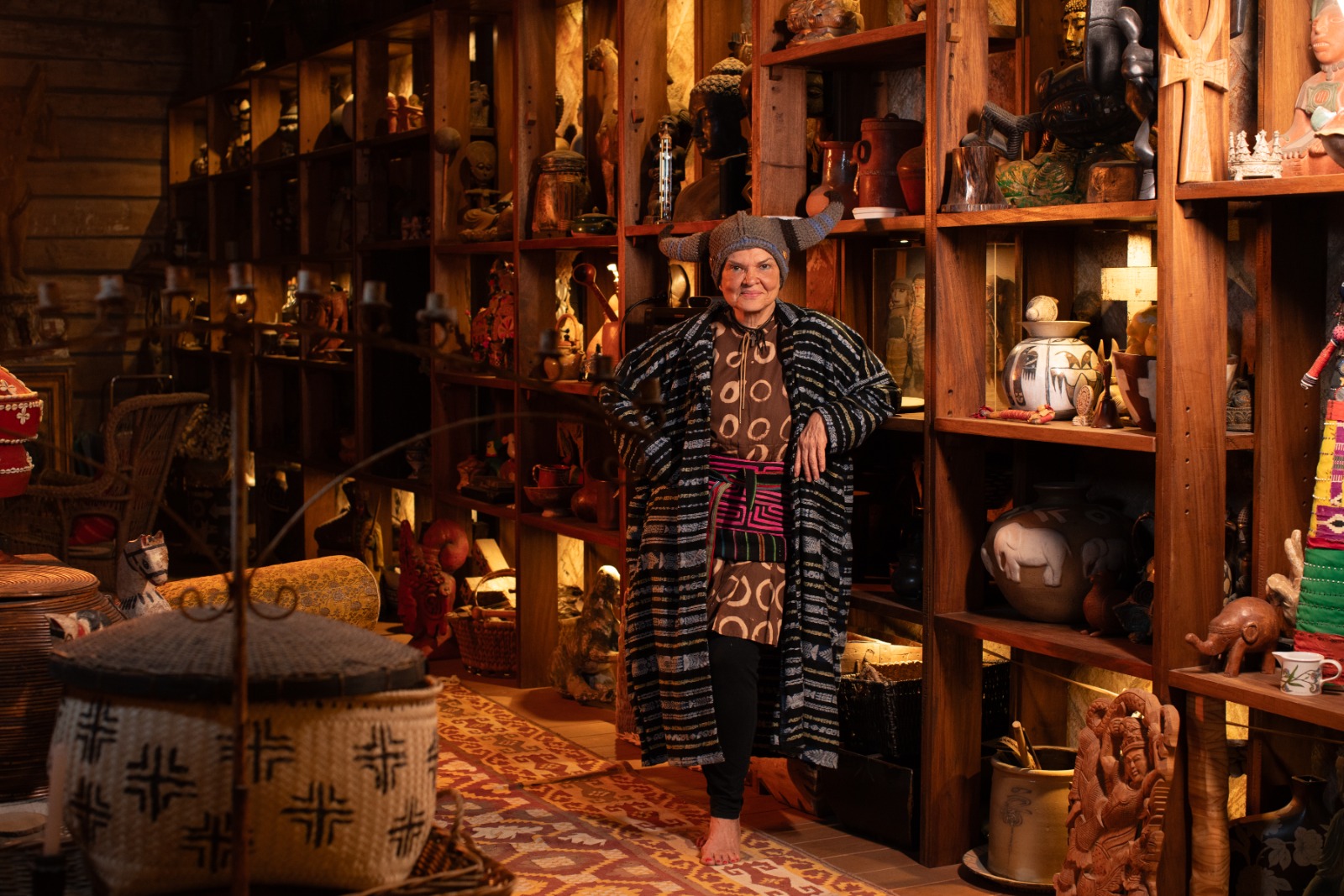
Angela Dillon was born in 1955 on the island of Campeche on the Gulf of Mexico and these South American roots play an integral role in her current work. Campeche is a small and primitive island and its earthy colours and textures are a constant element of Angela’s paintings.
She has developed her own technique, mixing her paint to her own recipe utilising natural pigments, waxes and gel to create a thick glossy finish that is unique. This thick foundation of paint is the ideal counterpart to the various other mediums that Angela utilises. For example, the thousands of small dried fish that flow across the shining black slick of paint on the canvas of Paradiso. The painting is a direct allusion to the environmental destruction of an area, known to many as “Paradise” because of its natural beauty, by an oil slick.
Angela began painting when she was 23. She was influenced by those whose approach to medium was similar to her own, and the Mexican artists whose use of colour reflected the environment in which she had grown up.
More recently, a connection between some of Sean Scully’s miniatures and Angela’s larger canvases has been noted. This is not surprising: both have had contact with the Navajo Indians, whose textiles were a powerful influence on Scully. Scully’s works, which Angela experienced when she first emigrated to Britain, provided her with a channel back to her previous experience with the Navajo Indians when she had spent time studying their sand paintings. Hence, the two elements — the design of the textiles, and the style and technique of the sand paintings — combine in Angela Dillon’s current work.
In many ways these works are intensely personal and express the most deeply felt emotions. Yet, in addition, they invariably include a message that has direct and potent relevance to the wider world. At times Angela has had to confront issues that relate globally and question our international perception of human rights and concern (or lack of it) for the environment.
In several of these works there are direct references to events and people. In particular, Homage is a tribute to Rigoberta Menchú, the Guatemalan poet and winner of the Nobel Peace Prize. Through her poetry, Rigoberta Menchú has tried to represent the many known and unknown victims of persecution in South America. For Menchú, poetry is her vehicle to create a dialogue with the outside world.
Similarly, Angela Dillon’s works, though they draw enormously on her personal experience, are also a vehicle for communication with the rest of the world. In Homage, Angela again combines an object that is a direct reference to the subject. On this occasion the thick impastoed paint is scored, slashed, and etched with the outlines of skeletal heads. The foreground is taken up by a heavy canvas sack of the sort made by prisoners. Smeared with grease and grime, the sack is a metaphor for the land that has been denied from the indigenous Indians of Mexico and Guatemala — in particular, the Mayan people of Angela’s home.